
AVAILABLE ON AMAZON: CHRIS RAEL'S GUILT SPORT

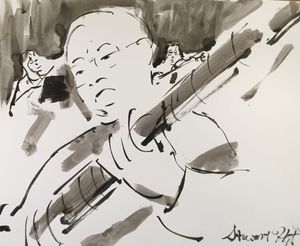
Live concert sketch by Stewart Hoyt
Haiku #9
Poems for poets
Do not come cheaply, for the
Words must do their job
ESSAYS
- Jan Kotik art exhibit catalog: DOX Center for Contemporary Art, Prague 2012
- The Birth of Alex: home, hospital, and bringing it all together at St. Vincent's 2/14/2010
- Ground Zero: a bike ride to the site 10 days after the attack 9/21/2001
- Culture Shock in Shangri-La: the modernization of Ladakh, Earth Island Journal, fall 1989
- The Rotating Worlds of Love: concert review, Ear Magazine 6/26/1987
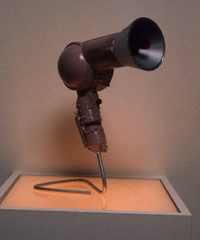
THE MUSIC OF JAN KOTIK
Forces of Resistance art exhibit catalogue
DOX Center for Contemporary Art, Prague, Czechia 2012
I met Jan Kotik when he was 17 years old. Eleven years older, I was a musician and record label owner who loved and championed Jan’s first band, the Mommyheads. Like their name, the Mommyheads were irreverent, their sometimes-juvenile contrarian sense of humor camouflaging an obvious deep intelligence. Late ’80s New York was a hodge-podge of artistic conventionality and utter creative rebellion. Interested in the latter, I was drawn first and foremost to the Mommyheads.
The group was absolutely original. Someone hearing it for the first time now would still experience it as unique and revolutionary. A compelling aspect was the simple fact of the group’s youth – that three such young men could produce such impressively mature concepts in sound. They were literal child geniuses.
As the drummer, Jan steered the group in uncharted directions. With a joyous sense of subversion, he concocted remarkably complex syncopated patterns for the simplest of rock songs. While there is little inherent value in musical complexity for its own sake, Jan created more than mere complexity: he applied it appropriately to seemingly inappropriate targets, making it amusing.
Often when a musician “overdoes it” the results are regrettable, but Jan pushed the envelope without crossing the line. He grasped the requirements of balance and taste in arrangement and was constitutionally incapable of defying them. How did he respond to these self-imposed aesthetic limitations? He challenged them as aggressively as he could, getting away with subtle perversities in approach while never destroying the beauty or dignity of a composition.
As with his visual art, there is sly humor just beneath the surface of Jan’s music. The first listen to a Mommyheads song could sometimes bewilder, requiring several listens to navigate through designed chaos to arrive at the simpler treasure within. At their shows I often laughed at the sheer audacity of their improvisations. Jan would mercilessly attack the boundary between the ridiculous and the sublime, bending but never breaking the song. It was fascinating and exhilarating to witness.
While band mates Adam Cohen and Matt Patrick are credited for most of the Mommyheads’ compositions, Jan drove the group’s sound with intrepid polyrhythmic expression. He pushed his band mates further than either would have gone without him. The youngest of the three, he was often treated like the kid brother. But when show time arrived, no one commanded more respect from musicians and audiences alike than Jan.
The younger son in an artistic family, Jan was organically expressive, fluent in language, concept, sound and vision. He was graceful and intuitive. A witty and critical social observer from the beginning, Jan navigated dichotomies in the roles of his youth: the mantle of his creative pedigree, the adulation of music fans, and – since he collaborated with many elders, including the other Mommyheads – a longing to impress and fit in with those he looked up to.
I believe the singular voice he discovered in Prague could not have blossomed until he had resolved these issues of youthful identity. The Mommyheads shared a cynical sense of humor beyond their years, tempered and bolstered by Jan’s reveling, childlike levities. Teenaged Jan was almost an auteur of silliness, though always intelligent and never cruel, but cutting.
These qualities translated to his taste in music at the time, which included noisy and challenging but smart art bands like the Butthole Surfers and Pussy Galore. These groups were menacing but conceptually eloquent and usually very funny, often at their own expense.
In 1990, Adam and Matt moved to California while Jan remained in New York. He promptly joined my group, Church of Betty, and made dazzling contributions to my music for years. At the time Church of Betty was even less pop than the Mommyheads, blending musical traditions of Asia and the West with challenging sonic inquiries filtered through New Music sensibilities and Downtown New York’s avant garde. Jan took to all this as naturally as a fish being released back into a stream.
He broadened the vision of my songs, taking them in tonal directions I could not script. Perpetually unassuming and sweet in personality, Jan looked up to older artists while expanding the horizons of their work, by either contributing to it directly (like mine) or simply broadening others’ perception of what was possible.
Ed Pastorini of 101 Crustaceans, revered in player circles as one of New York’s boldest and most challenging progressive composers, experienced him the same way. Jan was a game changer. A community-oriented artist who valued personal relationships as much as any work he made with others, Jan went on to raise the bar for groups like Beekeeper, Johnny Society, Ida, Babe the Blue Ox, numerous projects with his brother Tom, and probably a dozen other collaborations I didn’t even hear.
Jan’s sound ranged from the noise and chaos of his beloved Pussy Galore to the tight grooves of classic soul and pop, while covering much ground in between. Humor and poking fun at the self-importance of superficial popular icons was often nearby in Jan’s music. His father’s serious composition was another indelible influence on his conceptual sensibility.
Instrumentally, Jan was far more than a drummer. Like many in our circle, he was a multi-instrumentalist, handling the guitar, bass, and piano almost effortlessly. When Jonathan Feinberg became Church of Betty’s drummer in 1993, Jan shifted to guitar and embarked on a whole new chapter of transforming my music in surprising and delightful ways. Multifaceted, he was able to draw from a palette of skills and instruments to tailor his expression to the assignment at hand.
He was also a very good composer, though somewhat stymied by his vocal limitations. Nonetheless, he made effective use of his extremely deep voice, applying it convincingly and appropriately, often in service to the ever-present humor in his songs.
At this stage of his life, Jan’s politicization was rarely apparent in his musical performance. For one thing, most of his work at the time involved contributing sonically to others’ compositions. In the New York music scene, Jan functioned more as a color on others’ palettes than as a primary commentator. We would have to wait for him to move to Prague and shift focus from music to visual art to hear his political voice clearly.
The most politicized suppositions I heard Jan make in New York usually took the form of cultural commentary, often delivered with humor. The essence of popular culture is indeed politicized, and I believe provided a socially acceptable outlet for this young man to express himself within the etiquette of his art ghetto culture. Jan’s attitude was certainly an antecedent to the questioning of authority inherent in his later work.
While I was very gratified to observe from a distance my friend forging a new career as an artist in his homeland, I must confess his evolution took me by surprise. Jan was such a consummate musician, I never recognized in New York his underlying drive to create visual art.
When he moved to Prague, he didn’t keep musician friends in New York routinely informed of developments in his art career. I knew he was doing it, but didn’t appreciate the scope of his accomplishment until much later.
Perusing the images in this catalog, I find myself saying “oh yes, that’s Jan all right,” as if seeing pictures of a full-grown brother I hadn’t met in person since childhood. The quality of craftsmanship, the wry subtext of his choices, the steel wit and audacity all recall the young musical savant I knew in New York.
But I would submit that Jan’s political agenda, along with his need and ability to express it, grew by leaps and bounds in Prague. Following an exceptionally creative youth in New York, his voice reached maturity in Europe. I see the musical chapters of his life as distinct predecessors to his life as an artist and father in Prague.
It’s almost as if he experienced two lifetimes. Who knows how many more he may have forged if he had remained with us longer?
I considered Jan a deeply trusted partner and confidant. Our work together was very personal and his friendship will always mean the world to me. Dozens of musicians in New York share this feeling for him. I’ve little doubt that many who shared his art life in Prague harbor similar feelings for him.
The quality of the experience of creation is half the battle for any artist in any medium, and Jan heightened this experience for all in the vicinity of his creative process. All of his work, and indeed his life, are imbued with a rare and elevating quality that lifted all of us along with him.

THE BIRTH OF ALEX: Home, Hospital, and Bringing It All Together at St. Vincent’s
Brooklyn NY, Valentine’s Day 2010
When Vlada became pregnant with my son Alexander, she wanted to give birth at home. I hadn’t thought much about such things, but intuitively I was all for it. A 39-year-old woman having her first child is a higher risk candidate for home birth, but Vlada was exceedingly fit and constitutionally positive. She enjoyed a near ideal pregnancy. Every exam, every test indicated a healthy mother and baby. She had no morning sickness. Other than bouts of inevitable fatigue, she felt energetic enough to pursue her usual activities. She looked great – tall, lean, athletic with a basketball tummy.
All I needed to get on board with home birth was confidence that a sensible plan B was in place. We started by enlisting an experienced, no-nonsense midwife. I felt instinctive trust and professional respect for Joan. She was compassionate but direct, in command of her craft. I knew she wouldn’t hesitate to make the call should medical intervention become necessary.
Vlada and I didn’t know each other well when Alex was conceived. The pregnancy was a period of faith and discovery, romantic and supportive. To my astonishment, I didn’t wish for a second that it wasn’t happening. Our happiness cast a radiant veneer on our expectations for a natural delivery.
A former partner of mine questioned our judgment, belittling the choice of home birth at 40 as narcissistic and arrogant. Indeed, many seemed taken aback by our plans. Unfamiliar with these attitudes, I was puzzled by the conceptual resistance. Giving birth is a normal biological process, I figured. If there’s a problem, address it. But why begin in problem mode?
Vlada showed me Abby Epstein’s documentary The Business of Being Born, a scathing critique of the American birth industry. In keeping with my own insider perspective on the business of healthcare, I easily recognized the depicted trends motivated by expedience, assembly-line efficiency, and yes, profit. I believed hospital physicians would be quick to medicate and quick to cut, because that’s what they know, what they do, and how they must operate to keep pace with volume. I believed the quality of the mother’s experience, and the emotional introduction of mother and child, would be a decidedly lower priority in the hospital setting.
While my first concern was always their safety, I wanted Vlada to have a chance for the natural experience she wanted, to give birth in comforting, loving surroundings, to be alert and undrugged when receiving Alex into her arms for the first time. Armed with Joan’s experienced eye, our contingency plans, and Vlada’s dazzling health, why not try?
The due date had been estimated in the vicinity of January 15-17. With my birthday on the 16th, we wondered if father and son might share birthdays. Both Joan and Jamie, our doula, stopped by and declared our home preparations complete. Vlada visited Joan for weekly check-ups. The due date came and went. Alex remained strong. Everyone seemed fine; it was just taking a while.
Two weeks past due approached. No one panicked, but two-weeks-late is a red flag. On Friday the 29th, a sonogram revealed that Alex remained healthy as an ox. That night, I watched Vlada bravely accept the possibility she may have to relinquish her home birth vision. On Saturday, Joan ‘stripped her membranes’, a cervical procedure that sometimes facilitates labor. Late that night, the contractions started. Perfect! Finally.
“This is great,” I thought. “The contractions will be mild and far apart for hours. We can get some rest before the hard work starts tomorrow.” Which is just what happened. Perfect… Vlada endured contractions all Sunday, but they stayed short and far apart for a long time. We didn’t even call the doula til mid-afternoon. When Jamie arrived, the action started getting more intense. Vlada was in pain. “Perfect,” I thought. “She’s getting there.”
Jamie and I scooted around the apartment filling pools, cleaning utensils, massaging Vlada, timing contractions. They were getting longer and coming closer together. Vlada was truly suffering now. “Perfect”, I thought. “She’s hitting the wall, the moment you read about in the books, where they want to give up just before they deliver. We’re getting there!”
We finally summoned Joan, who examined Vlada at 11:30 Sunday night. She was only 2 centimeters dilated. We were shocked. All that work… Vlada had already labored an unusually long time. We thought she was almost done, when in fact she’d barely started. The decision to go to the hospital was a no brainer. Not surprisingly, Vlada relinquished her vision of a drug-free delivery. Inducement was needed, and pain relief loomed. The four of us piled into two cars for the Birthing Center at St. Vincent’s in Greenwich Village, one of the few hospitals that works cooperatively with midwives. Joan was affiliated there.
Still no panic. I felt confident in the outcome. We wouldn’t be able to do it the way Vlada had hoped, but the medical support would see her through. It was turning out that she was one of the women who legitimately needed it. After her already-long labor, there was a sense of relief for both of us.
We checked into the Birthing Center after midnight on Monday, February 1. It takes a while to get set up. First, she had to be hydrated before they could give her an epidural for pain. What a relief to see her relax in the midst of her arduous battle. They got the pitocin – inducement medication – going as soon as they could. Part of the vision of natural birth is the absence of pitocin, which can induce unnaturally powerful and painful contractions. It is now used routinely in most hospitals, and we didn’t want it used unnecessarily on Vlada. Of course now it was necessary, and we were counting on it.
The doctors at St. V’s were mostly in their 30s. To my 49-year-old eyes they seemed like kids, which was somehow positively energizing. These young professionals exuded competence and confidence, compassion and respect for their patients. Their bedside manner impressed me, as did their recognition of Joan’s credibility. When options were discussed, they did their best to preserve as much of the natural birth process as possible. It seemed to matter to them.
Things wore on unexpectedly. The pitocin worked slowly; Vlada’s dilation was plodding and gradual. Alex remained high in her abdomen. Meanwhile, the doctors became concerned about her body chemistry. Hours went by. Eventually they expressed concern that Vlada may be developing HELLP syndrome: hemolysis, elevated liver enzymes, and low platelet count. If the baby stayed in much longer, her kidneys could shut down or she could have a brain seizure.
“Well, let’s get him out,” I said. But it wasn’t that simple: C-section is high risk for women with HELLP syndrome; blood doesn’t clot normally. The doctors’ concern was palpable. The last thing they wanted to do was cut her. But Alex couldn’t stay inside much longer. When they broke her water, meconium – Alex’s prenatal waste – was found in the fluid. His overstay in the womb had him swallowing and breathing the same toxins that were endangering Vlada.
Remarkably, the doctors then turned back to Joan, the midwife. “We need you to do what you do in order for us to do what we do.” They asked Joan to work with Vlada to push the baby down as far as possible. They didn’t want to cut. If Vlada could push him down enough, the doctors could retrieve Alex by other means, and he could be delivered vaginally. This was the only route to safety for mother and child. The toxicity in Vlada’s system would naturally subside with the successful delivery of Alex.
How’s that for a scenario turning the childbirth conversation on its ear? The medical contingent needed the naturalists and vice versa, and we needed them all. Full cooperation between all caregivers was critical. Joan urgently guided Vlada’s pushing, expertly repositioning her periodically, encouraging her every step of the way. I was at her head and Jamie was at her feet; the nurses were also deeply involved. Vlada worked like a warrior for an hour-and-a-half, sometimes making progress (measured in painstaking millimeters), sometimes not.
The doctors would check in periodically, encouraged to see some progress, but not impressed nearly enough. Finally a deadline was established. Joan had one half-hour more to move Alex down. If he wasn’t down far enough by then, they would have to resort to a high-risk emergency Cesarian. I stepped outside for some air. The labor had been so grueling. I couldn’t comprehend the physical magnitude of Vlada’s task. It seemed he’d never come out. I never stopped believing in them for an instant, but had to face the possibility that either or both of them might not make it. So tired, so difficult… I had to be strong for them. She could not falter, so neither could I.
We went back to work. Joan, Jamie, the nurses and I gathered around Vlada like faith healers, voices rising with each contraction, summoning my son into the world. Vlada pushed in resolute silence over and over again, achieving the seemingly impossible in micrometers. Our evangelical-toned cheerleading and the building drama began drawing curious glances from hospital staff, ducking in and out of the room.
After half an hour, the moment of truth came. Kyle, a young, kind and level-headed doctor, would make the call on whether he could help Alex out via either forceps or vacuum delivery. Upon examining her, he nodded his head in approval. Vlada had achieved her goal. Kyle would attempt a delivery by forceps.
Forceps and vacuum deliveries both incur some risk; head injury to the baby is possible. Forceps are considered lower risk than the vacuum procedure, so they started there. Doctors Kyle and Maurice attempted to position the forceps for some 10 minutes before Kyle declared he would not make the attempt. He did not feel confident he could position the forceps effectively without risking injury to Alex. Never had I felt such gratitude for the caution and humility of a doctor. Instead the team would attempt the higher-risk vacuum delivery, necessary in this case.
The vacuum procedure consists of placing a suction disk on the baby’s head, adhering it, and literally yanking him out by means of a strong cord. The yank must be timed with the mother’s contractions; the mother must help. In our high-tech world, there’s something almost primitive about the process. In this instance, it made simple and elegant sense.
In the first attempt, the suction disk popped off Alex’s head, flying out of Vlada with a whip-like crack. For a split second I had the bizarre illusion of my son’s head popping off entirely. “Whoa!” Joan and the doctors assured us this was not unusual and could happen several times before achieving success. Indeed, the second and third attempts yielded the same nerve wracking result.
I was positioned at Vlada’s head, whispering loving encouragement in her ear, supporting her neck during her pushes. From this vantage point, I saw most of the medical staff gathered at the back of the room, watching with baited breath. The ring of four doctors poised around Vlada and the rest in the back shared facial expressions taught with utter suspense. The scene surpassed any television ER melodrama I’d seen.
Attempt number 4: “Go Vlada! Push push push! That’s it!” Holding her neck and shoulders, with a slightly higher sight line than Vlada herself, I saw the somewhat compressed, gooey head of my little boy emerge into the light. Kyle was pulling hard, applying serious muscle at strategic angles to protect the baby’s fragile neck. “Omigod!” The excitement of this moment transforms the energy of the body. “Keep going Vlada! Don’t stop!” My exhausted heroine bore down once more. In a moment, the rest of Alex’s body slipped out. After 46 hours of labor, my son was born.
Such exhilaration! The closest thing to it I’d experienced was my first glimpse of the Grand Canyon, which literally sucks the air out of the lungs, making one light in the head and acutely alert at the same time. “Baby you did it!” Vlada immediately stretched out her arms. “Can I hold him?” I knew the answer was no; Alex was swept to the adjacent room to be checked, before his visit to the neonatal ICU. “They have to take him to make sure he’s okay, baby. You can hold him in a minute.”
We held each other in wonder and relief, hugged Joan, thanked the doctors as they sewed stitches into Vlada. From the next room, we heard Alex’s first cry – the sweetest sound in the world. Soon I was called in to see him. He was beautifully funny, slick, red in the face (some abrasions and skin irritation from his harrowing journey), and somehow old-manlike. The little guy seemed to have been here before.
He was big! Almost 10 pounds, long, gangly, lots of hair, curiously powerful. He was feisty. Even with meconium in his lungs and stomach, he was hearty. The placenta was big as a Frisbee; no wonder he was lodged so tightly. Before heading to the NICU, the nurses brought him to Vlada, who held him for the first time. A tender, unforgettable sight.
The NICU doctors and nurses took excellent care of Alex for several days, while Vlada recovered her strength upstairs. This story is populated with heroes and people doing their jobs well, starting with Vlada and Alex, to Joan the remarkable midwife, Jamie the doula and me, to the kind and attentive nursing staff at St. Vincent’s Birthing Center, to the caring and competent doctors in the delivery room, NICU and recovery wing. Everyone was incredible. Their combined efforts saved my new family’s lives.
I feel deeply fortunate (and grateful to Joan) that we brought Vlada to St. V’s. It is a rare facility in its openness to midwifery, while providing state-of-the-art medical care as needed. I honestly know of no other place in the city where we could have expected such a wondrous outcome. The unique blend of medical support and midwifery Vlada needed was not readily available elsewhere.
St. Vincent’s is a New York treasure. It works. Lives are saved there every day. Without it, lives would be lost. Without it, my child and his mother could have been lost. Unbelievably, it is now in danger of being closed, its services lost to the community. Why? Because of a hostile corporate takeover by another hospital.
Beth Israel is engaged in buying out St. V’s, as hundreds of larger corporations have taken over thousands of smaller ones. Beth Israel aims to take over St. V’s and shut it down, in order to drive more business to itself. It’s not personal; it’s just business. That’s the way capitalism works, right? Except this is a case of healthcare providers taking healthcare away from the community, for their own profit.
I don’t know what we would have done without St. V’s. I will never forget their caring, their kindness, their faithful and professional fulfillment of their mission. This is practically unheard of in New York City. By definition, the loss of any New York hospital guarantees more death in the adjacent community. Those who would close a hospital are therefore directly responsible for this death. That those who would facilitate such death-for-profit are healthcare providers is grotesque and cynical beyond description.
The directors of Beth Israel should be hung by their Hippocratic oaths. If they succeed in closing St. Vincent’s, they will have blood on their hands. These criminals can lay no claim to care for life, much less save it. I’ve been in their emergency room and believe me, if I got hit by a bus in front of Beth Israel, I’d hold out for the ambulance to St. V’s across town.
New Yorkers, don’t take this lying down. We cannot afford to lose this critical facility. We need St. Vincent’s. The hostile forces at Beth Israel masquerading as providers of healthcare must be exposed for their shameful actions. Visit HYPERLINK "http://www.savestvincents.com" www.savestvincents.com today, and add your voice of resistance to this disgraceful attack on a lifesaving institution.
Thanks to St. V’s, my story has a happy ending. It casts some interesting angles on the home-birth vs. hospital-birth debate. Any differing decision by us, or any of the caregivers, at any juncture could have yielded very different results. One could second-guess or coulda-woulda-shoulda til the cows come home. All I can say is I felt surrounded by committed, loving people at every juncture through this process, for which I’ll be eternally grateful. As challenging and frightening as it was at times, it was a journey imbued with value that will frame the beginning of my son’s life with even richer meaning. Such heightened appreciation for the preciousness of life is an inspiring start to our new family’s adventure.
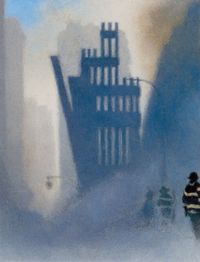
GROUND ZERO
A bike ride to the site 10 days after the attack
Chris Rael 9/21/01
Art: James Williamson
It's been 10 days since the Trade Center came down. I have been deeply sad and terrified. My gig last night was tough, like playing injured, but people came together. I felt within myself a twinge of a strength I have long suppressed. A calamity can rip the scar tissue off ancient wounds and provide strange opportunities to grow.
Had a business meeting tonight, lawyer and record label. Was in bed moaning and throwing up all day. Exhaustion, both physical and mental, topped off with too much heart-numbing booze at the gig last night. Rallied for the meeting, set out confident and balanced. Business makes me uptight, but after last week, who gives a shit? We all met and talked for a long time about the tragedy and our worries about the future. The record guy lost someone; he went to the memorial last night and bottomed out.
We talked about business and it went very well. Said goodbye on the corner of Broadway and Bleecker, and I pointed my bike downtown toward Ground Zero.
Last night at the gig, some friends told me you can now get close enough to see. I was obsessed all day but too ill to go. Now I went. It was 10 pm and the city was quiet, as it has often been since the attack. I rode to Canal Street, where the barricades repel the cars. The cops allowed me to pass on bike. At Chambers, they barricade the bikes but you can continue on foot. I locked my bike up by City Hall.
The area smelled like India, smokey dirt hanging in the air. Probably a combination of dust from the rubble and heavy vehicle exhaust. They've done an incredible job of hosing down the streets, but there's still a thin layer on everything, again like India.
My friend John's street, appropriately enough called John Street, was all ripped up; power workers worked on power lines feeding juice to the site. John's building was shrouded in grime. Past the church was the first view, an enormous twisted piece of metal dangling from an adjacent building. The angle seemed unlikely. I couldn't tell what I was looking at.
At Maiden Lane you could see more. This is all from Broadway, still a couple blocks away, the view limited by buildings lining both sides of the street. With the floodlights on, it looked a lot like it does on television.
At Liberty, you could see the train-tracky bent metal exoskeleton clawing toward the sky like a gnarled hand. The smoke and the night and the floodlights made it look mysterious and ominous, a strange landscape from an Arthurian legend or maybe a Heinlein novel. It's bigger than it looks on TV. I hear they may pull it down on Tuesday.
At this distance the air starts to smell like when a rat dies under floor boards. I thought again of India, where the smell of death is part of everyday life. I thought of all the turbaned heads on the news, men with beards from a part of the world that I love, who will now be reflexively viewed as The Enemy. People like my close friend and music partner, who isn't Muslim and is fanatical only about music, will encounter misplaced hostility because of the hijackers, who are all dead.
Knots of people like me peered through the fences, pensive and sober and loving. A mom explained things to her teary daughter, probably 12 years old. Photographers snapped, but there wasn't much to snap from that angle.
Like practically everyone, I have been devastated for 10 days. Tension, irritability, fear, and a very broken heart... I felt stronger after the business meeting and wondered if I'd get upset again at the site, but I had to go. As it turned out, I felt calmer than I have in days. Seeing it planted the seeds of a healing acceptance.
Walking back to my bike, I saw one of my wife's favorite Odd Job stores, closed up tight and smeared with ash. I passed the street of the Knitting Factory, New York's notorious new music nightclub, sealed up for days because no one can get there. I thought of concentric circles of victims: the families of the dead, the businesses in the area, the eyewitnesses from a distance like me, everyone watching on television. The closer you were, the more it hurt.
As I approached the final barricade at Canal Street, a 3-wheeled bicycle rickshaw cab was bringing a couple people down to the site. In the night mist, with no traffic around, it seemed again like I was back in India, where this is a very familiar sight. My worlds are somehow joining into one, I thought.
There's a lot of love in New York right now. A lot of fear and a lot of crap too, to be sure, but with each day the atmosphere of panic dissipates a little, giving way to a deep but placid depression. The stillness isn't all bad; people here need some peace. The cops and rescue workers are getting a lot of love which, I discovered tonight, they are giving back accordingly. They truly deserve our gratitude.
I'm glad I went to Ground Zero. Somehow it gave me hope that life in New York will be tolerable again soon. That, of course, barring further attacks. Peace is the most important commodity of all; you don't completely know this until you have experienced the alternative. Sometimes we fight for peace. I just hope we fight correctly and do not commit crimes equalling or surpassing those of the terrorists. Enough innocent people have died already.
Peace & love from New York City
CULTURE SHOCK IN SHANGRI-LA
The modernization of Ladakh
Earth Island Journal, fall 1989
When the sun over Ladakh moves behind the mountains of the the Karakoram range and the temperature plummets, you know you're in the Himalaya. This is the spot the tourist brochures call 'the last Shangri-la'. Perhaps it is.
Perched high in the Indian Himalaya, Ladakh is a romantic, isolated region where people have achieved rare harmony with their harsh environment and each other. The land is barren, the mountains are steep, the air is thin and winters are long and relentlessly cold, yet the Ladakhis have not only survived, they have prospered.
Today, a stampede of foreign visitors carrying modern consumer products, fashions and values threatens to destroy one of the most successful human ecosystems on the planet. Western industrial culture has smothered traditional cultures in the age of mass communication and transport. The question is, can anything be done about it?
In terms of gross regional product, Ladakh is one of the poorest places on earth, but the quality of life is high. Almost all Ladakhis are well housed, well fed, and well clothed. But the greatest evidence of prosperity is the serenity and happiness of Ladakhi people. Kind, gentle and filled with humor, they have lived peacefully for generations.
This stark, beautiful, high-altitude desert has never given its people much to work with. The most sophisticated agri-business would be hard pressed to make anything grow here. Ladakhis expertly glean every possible resource from the fragile environment. Lacking the means to master the land, they live as part of it.
Wood is scarce, so villagers dry and save animal dung for winter heating fuel. Mud, on the other hand, is abundant and makes excellent weather-resistant homes. Farmers use only as much land as irrigation will allow; they graze their herds just enough to allow pastures to recover.
Nature's apparent lack of generosity has hidden blessings. There is no sugar in the traditional diet, so Ladakhis have strong teeth. And because they have to climb to go just about anywhere, there is no need for aerobics classes.
Most families own their own land and provide for themselves. So little rain falls that farmers channel water from melting snows and glaciers to their terraced fields through long canals. They labor through the short growing season and then retreat into stone or mud-brick homes for a leisurely winter of crafts and story telling, religious celebrations, and enjoying family and friends.
This seasonal cycle and the tenets of Tibetan Buddhism anchor a remarkably stable society. Social unrest and crime were virtually unheard of before recent modernization.
In-roads of Civilization
In response to the Chinese war in nearby Tibet, the Indian government first built a hair-raising but functional road through the mountains to Ladakh in 1962. The Indian army is still there. In 1974 the area was opened to tourism, and Ladakhis have dealt with rapid and confusing change ever since. Development has interfered with the ecosystem, and Ladakhis' perceptions of themselves have changed dramatically.
Imagine growing up in a place where everyone toils to squeeze life's essentials from unyielding soil. One season, thousands of foreigners appear, each one carrying a wad of traveler's checks worth more than a farmer makes in a year. They hang around for weeks on end without working. They pay ludicrous amounts for alcohol and souvenirs. Bearing wondrous devices from the world beyond the mountains, such as cameras, cassette players, and clothes made from synthetic fabrics, they seem to lead carefree and glamorous lives. Ignorant of the complex problems facing Western civilization, most Ladakhis feel poor and backward by comparison.
The psychological impact is particularly strong on young people. "Before 1974, Ladakh was not known to the world," wrote a Ladakhi child in a recent school essay. "People were uncivilized. There was a smile on every face. They don't need money. Whatever they had was enough for them."
Now instant food, blue jeans, sunglasses and cigarettes are in demand. Sometimes Ladakhis' ideas about modern conveniences are dangerously inaccurate, as when women discard the traditional stone slab to bake bread on sheets of asbestos. Regardless of their practical value, imported products cost money. For the Ladakhis, abandoning their farms to look for work in the provincial capital of Leh (population 10,000), the region's paltry GRP suddenly makes a huge difference. An area this devoid of resources must depend on outside help to survive in a money economy. The only tenable commodity is tourism, which threatens to overrun the culture.
Modern Miseries
The Indian government's efforts to modernize Ladakh have compounded problems. Concrete homes, constructed to provide more modern housing, don't insulate people from the brutal Himalayan winter nearly as well as mud. Expensive imported fuels are now needed to fight off -50°F nights. The government also introduced chemical fertilizers and new breeds of livestock. Unfortunately, the new animals struggle in the thin air. Although crop yields shot up with the fertilizers, the quality of the fragile soil is deteriorating; new vegetables lack heartiness and taste.
The most visible problem, however, is pollution. Exhaust from trucks imprting merchandise and taxis serving tourists intermingle with the ever-present dust, casting a brown haze over Leh. Tourists and Ladakhis alike use laundry soaps and other synthetic products in local streams. Unaware of health risks, townspeople still drink from these waters. Leh's streets, once free of biodegradable litter, now host an array of pop tops, candy wrappers, bottles and butts.
The vast majority of importers and merchants are Kashmiris and Sikhs from neighboring regions. Except for those running guest houses, Ladakhis see very little of the money brought into the area by foreigners. In summer, when Leh is crawling with tourists and merchants, the townspeople look like a ghettoized minority on their own Main Street.
As modern influence grows in Leh, many accept the deterioration of their town as the price of progress. Development is inevitable, but it is possible for Ladakhis to broaden their perspective on the choices now confronting them. If they are aware of the problems of Western industrial life, they may be less inclined to accept the whole package with blind faith. If they can use simple, locally feasible technologies to increase their productivity, they may avoid environmentally destructive, centralized operations such as diesel projects and hydroelectric plants. And if they realize the West simply does not experience the quality of traditional Ladakhi life, they may be able to renew their heritage.
'Counterdevelopment'
The Ladakh Project is helping to make these possibilities realities. Since its inception in 1978, the project has offered alternatives to economic dependence and environmental exploitation. The group has initiated dozens of campaigns, educational projects and programs in Ladakh, as well as educational reports and funding presentations abroad. It has also introduced numerous human-scale technologies to the area, proving to Ladakhis that they need not abandon their land and culture to improve their lives.
The project was founded by Helena Norberg-Hodge, a Swedish linguist who came to Ladakh with a film crew in 1975. She stayed and became the first Westerner to learn their language. She also had a good look at traditional life before the tourist explosion. Her language skills gave her unique insight into development trends, which she observed from their beginning.
Today the Ladakhi Ecological Development group (LEDeG) handles local issues, while the Ladakh Project is an international organization based in Bristol, England. Norberg-Hodge sometimes calls LEDeG a "counterdevelopment group". While the group does try to counter present development trends, it is not anti-development. LEDeG endorses ecologically sound development. The paucity of resources, investors, and pro-industrial political forces in Ladakh makes it ideal for the ecologically conscious approach. And so far, the Ladakh Project has enjoyed significant success.
The original goal was to find an alternative to imported heating fuels. Poor in fossil fuels, Ladakh receives an abundance of sunlight - the ultimate clean and renewable energy source. The Project introduced the Trombe wall, a double layer of glass attached to the outside of a black wall with vents built into a heavily insulated living space. The wall stores heat all day and radiates it into the room after the sun sets. A Trombe wall costs about $300 and requires little maintenance. Much of it can be made with local materials; it works well in stone or mud brick rooms with straw insulation. There are now over 100 Trombes throughout the region, and the demand is growing. Their popularity is a victory for the Project.
LEDeG's "appropriate technology" projects are intended to help farm families remain self reliant. A crucial issue is electricity, which is now provided by a few diesel-powered generators in the Indus Valley and an inconsistent four-megawatt hydroelectric plant. Such systems are expensive, environmentally destructive and favor urban areas. LEDeG has responded with an improved water mill for grinding grain and providing power for electricity. One water mill can provide electricity for 15 houses.
Grinding grain is an integral part of traditional village life, but people have begun taking their wheat and barley to the diesel mill in Leh. The improved water mill is slower than the diesel, but it grinds five times faster than the traditional method. And because it doesn't heat the grain like the diesel, the product is healthier.
LEDeG has developed other devices: solar ovens, water heaters, crop dryers and greenhouses that extend the growing season to make fresh vegetables available throughout the year. It has also designed an inexpensive ram pump for irrigating once-unusable areas. All of these technologies can be built and maintained by local craftsmen with mostly local materials. And because all utilize sun, wind and water power, they encourage economic independence and ecological harmony.
Appropriate technologies have had substantial physical impact in Ladakh. Their successful implementation reflects the commitment and efficiency of the Ladakh Project. But many other Western-sponsored development projects have proven inefficient and detrimental to developing areas. How is this one different?
Right Livelihood
The remarkable dedication and energy of Helena Norberg-Hodge is an obvious factor. She has given 10 years of effective fundraising, organization and leadership. The Norwegian government aid agency NORAD began funding a large part of the project through her efforts. Her speaking tours have attracted support and educated Westerners about Ladakh. In 1986, LEDeG received the Right Livelihood Award, or 'Alternative Nobel Prize', for environmentally sustainable development. Norberg-Hodge's work has also been praised by Indira and Rajiv Ghandi, the Dalai Lama and Sir Edmund Hillary.
Most important, Norberg-Hodge successfully cultivated the interest of Ladakhis by addressing their everyday needs in a changing environment. She shared her global ecological perspective with them by applying it to specific local situations. This is something most developmental aid agencies fail to do.
Sitting on a mat in the library of the Center for Ecological Development in Leh, Helena Norberg-Hodge talked about the impact of development. "I think that the problem is that you really can't generalize about different cultures and the development appropriate for each area.," she said. "However, today development everywhere is based on one Western industrial model. The problem is that most development agencies, even many of those looking for alternatives to conventional development, tend to be profoundly 'Eurocentric' in their thinking. And then, of course, I think that unfortunately many of the aid organizations are very much linked to self interest in the industrial countries."
The success of LEDeG might baffle Western efficiency experts because the group is very loosely structured. It reacts to trends, changes and movements; there is no systematic analysis. Over the years Norberg-Hodge and field manager John Page have played large roles in decision making, but Norberg-Hodge asserts it is the "all-around knowledge" of Ladakhis that shaped LEDeG.
"To a very great extent that's a product of the traditional society, where you had many more 'renaissance' people and a type of renaissance education," she said. Loose structure has given LEDeG its flexibility. Specialization and bureaucracy have become ingrained in industrial society. LEDeG provides proof of the advantages of generalized, maller-scale operations.
The Ladakh Project tries to view Ladakh in a global context and works to educate Ladakhis so they may do the same for themselves. Seminars are held at the Center for Ecological Development, which serves as a demonstration center for appropriate technologies and houses a library, a restaurant and various exhibits. It is a point of interest for tourists, who also learn about recent change in Ladakh.
LEDeG has held seminars on agricultural issues, Muslim-Buddhist relations (which have deteriorated recently), Buddhism and ecology, future development options, and health hazards such as smoking and junk food. It has also waged clean-up campaigns in leh, and explored changing attitudes toward Westernization through radio shows and live plays, a popular traditional art form. LEDeG is building a center for traditional medicine to support the holistic, natural approach of the traditional healers or amchis, who are now threatened by Leh's poorly equipped Western-style hospital.
It has even created a program to help farm families make some money. Most traditional arts and crafts have religious significance. Ladakhis feel it is inappropriate to sell these religious objects as souvenirs, so a new line of handicrafts based on traditional crafts is being developed. People could work on handicrafts during the long winter months and sell them to tourists in the summer. This new income could help families stay on their farms and out of Leh's Westernized job market.
Growing Up Ladakhi
Perhaps the youth of Ladakh are LEDeG's most important audience. Children are growing up in a very different world from their parents, and it is imperative that they consider the pros and cons of old and new. LEDeG organizes essay contests and discussion groups at schools. Some young essayists describe threats to their culture with eloquence: "Fashion is not a matter of progress. It influences the Ladakhi culture directly and makes it poor," writes one. Another laments, "In the city, the houses and hotels will cover the whole area. The fields growing wheat and barley will also disappear. The development purposes will be fulfilled."
The Ladakh Project sees a great need for its work and plans to expand as quickly as possible. It already plays a monor role in Bhutan, at the request of the Bhutanese government. With Thupstan Chhewang directing LEDeG, Helena Norberg-Hodge will probably work more in industrialized countries.
"There's a growing awareness of ecological problems in the industrial countries," she says. "And yet, even though many people appreciate efforts like ours in the Third World, they are much less keen to strive for change in their own countries. I think that Ladakh could become quite an important model for other parts of the Third World and the industrialized countries."
It could indeed. The prosperity of traditional Ladakhi life is so foreign to modern experience that we should learn from it. The ability to stretch resources seems a vital lesson in particular. Thanks to the Ladakh project, the development process has also been observed and described here from its very beginning, giving us a chance to study and reevaluate our once-unquestioned development methods.
But the lessons of Ladakh must be explained in more quantifiable scientific terms than these to have impact in the West. For those of us who have seen it, the warm Ladakhi smile is intangible evidence, unverifiable data. The fact remains that these people are free of our compulsions to fight our way up a ladder, to measure success in material terms, to attain wealth at any cost - the same values that drive us to destroy our environment and eventually ourselves.
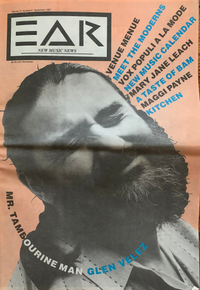
THE ROTATING WORLDS OF LOVE
Concert review, Ear Magazine, Knitting Factory NYC 6/26/87
Calling themselves The Rotating Worlds of Love, David Garland, Cinni Cole and Ikue Mori performed a short, entertaining set of semi-improvised music. The trio presented a thoughtful, often-humorous collection of sounds, improvising within established song structures to create a sense of disorder within order.
Cole played synthesizers, Mori operated percussion programs, and Garland used an array of odd electronic instruments as well as voice and flute. The opening number featured Cole improvising on synthesizer while Garland made high-pitched wailing sounds on an ancient theremin. One of the first electronic instruments, the theremin is controlled by moving the hands toward and away from its antenna, enabling Garland to perform theatrical hand gestures while playing.
Garland sang several songs, his droll lyrics, rich baritone and sincere delivery combining to produce a haunting, provocative effect. Cole displayed her versatility on several keyboards, exploring a wide range of sounds without deviating from her own recognizable style. Mori often let the keyboardists create a steady, hypnotic sound before breaking it up with clattering percussive accents. This technique was particularly effective because she deliberately kept her volume at an unobtrusive level.
One of the songs was a simple love story: boy meets girl, dad hates boy, boy and girl anguish, girl sneaks out with boy. To interweave such lyrics with outbursts of improvised cacophony may sound facetious, yet Garland sang the story with an endearingly ingenuous touch.